

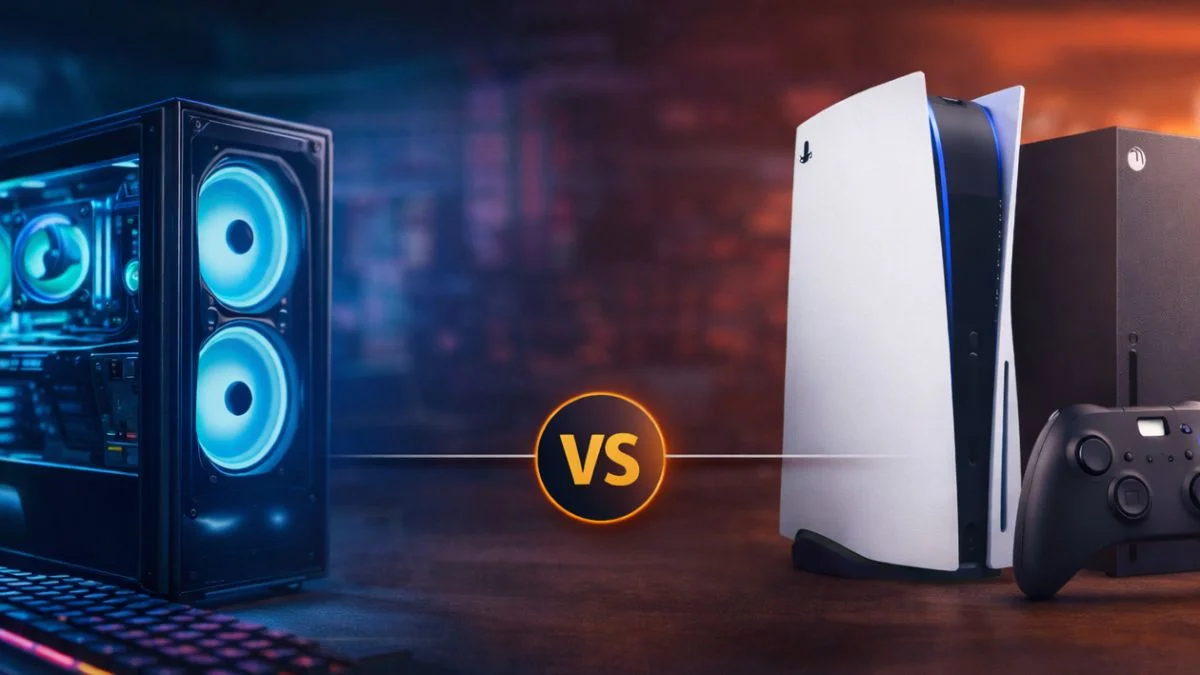
PC vs console is one of the longest-running debates in gaming. Both platforms offer strong performance, popular titles, and loyal fan bases. But when it comes to long-term value, not just the upfront price, the answer is more complex.
Difference Between Console vs PC Gaming
Let’s look at the difference between consoles and gaming PCs.
| Factor | Console Gaming | PC Gaming |
| Upfront Cost | Lower initial price (e.g., PlayStation 5, Xbox Series X) | Higher initial investment for good performance |
| Long-Term Cost | A new console is needed every 6–7 years | Upgrade parts instead of replacing the whole system |
| Performance | Fixed hardware, optimized for its generation | Adjustable settings can exceed console performance |
| Upgradability | Not upgradeable | Fully customizable and upgradeable |
| Game Prices | Fewer deep discounts | Frequent sales on platforms like Steam and Epic Games |
| Ease of Use | Plug-and-play, minimal setup | Requires setup, driver updates, and maintenance |
| Game Library | Strong exclusives, limited ecosystem | Wider library, mod support, cross-platform titles |
| Online Services | Often requires a paid subscription for multiplayer | Online multiplayer is usually free |
| Versatility | Mainly gaming and streaming | Gaming + work + content creation + streaming |
| Longevity | Tied to console generation cycle | Can stay relevant longer with upgrades |
Upfront Cost & Long-Term Investment
At first, a console is cheaper than getting a PC, such as the PlayStation 5 and Xbox Series X, when it comes to a new console. Consoles may be less expensive initially than PCs, making them ideal for casual gamers or families that want simplicity.
In general, however, an initial investment in the gaming PC will result in a higher total cost than a gaming console. Entry-level gaming PCs will typically cost more than consoles, and many high-end systems will cost much more than a gaming console.
Over the next five to seven years, this scenario may change. Each new generation of console is typically released every 6-7 years, while older hardware will usually be left behind by the time a new console is released. In addition, you can upgrade a gaming PC over time rather than having to buy an entirely new system for a replacement; you can upgrade one component, such as the video graphics card or add another gigabyte of RAM, for example. The long-term value of PC gaming is often much stronger than that of console gaming.
Initially, consoles are less expensive. PCs tend to provide better long-term value.
Performance and Graphics Over the Years
PCs can have better control over graphics settings, frame rate, and resolution. The hardware in a PC will give you a greater frame rate and smoother performance than most consoles, if properly configured.
While consoles provide solid performance for the amount of money spent, their performance is capped by the fixed hardware configuration. As games progress and become more hardware-intensive, the performance on consoles can feel constrained. You can upgrade the graphics card and/or CPU on a PC to continue to produce acceptable performance with newer releases.
In general, if you want a game to be played at the highest level possible for years to come, then the PC generally provides the best possible chance for this type of longevity.
Overall, the PC provides greater flexibility in terms of long-term performance.
Game Library and Pricing
There are many different digital stores to buy games on PC, including Steam and the Epic Games Store. Since often there are discounts, seasonal sales, and bundles available on these platforms, gamers generally can save a lot of money on PC games over time.
While consumers can often find digital downloads or subscriptions from console manufacturers, they usually pay more for games for a longer amount of time.
In addition, a lot of the games that have been exclusive to consoles in the past eventually come to PC. However, some franchises remain exclusive to Nintendo consoles.
Overall, PC is typically the better option for gamers to save money on video games in the long run.
Ease of Use and Maintenance
Consoles are easy to set up because there are very few things that require maintenance after installation, except for software updates. Gaming computers require more care due to needing driver updates, being cleaned from time to time, as well as changing settings; however do not present an undue amount of complications and require just a little involvement.
Individuals that chose consoles will see they are more practical for simple use and ease of being able to play games without any adjustments necessary.
Versatility Beyond Gaming
A console is made to play games and watch streaming media. A gaming computer can be used for working, creating content, browsing the internet, and streaming, in addition to playing games.
The different uses of a gaming computer create a higher value than a console and provide additional use for those individuals who need a device for more than gaming.
So, if long-term value means lower upfront cost and minimal effort, consoles are the better choice. But if long-term value means flexibility, upgrade potential, better performance over time, and broader use beyond gaming, a PC holds the advantage.
So, there is no single winner for everyone.
Also Read: 16GB vs 32GB RAM For Gaming In Late 2025: What Really Matters Right Now
