

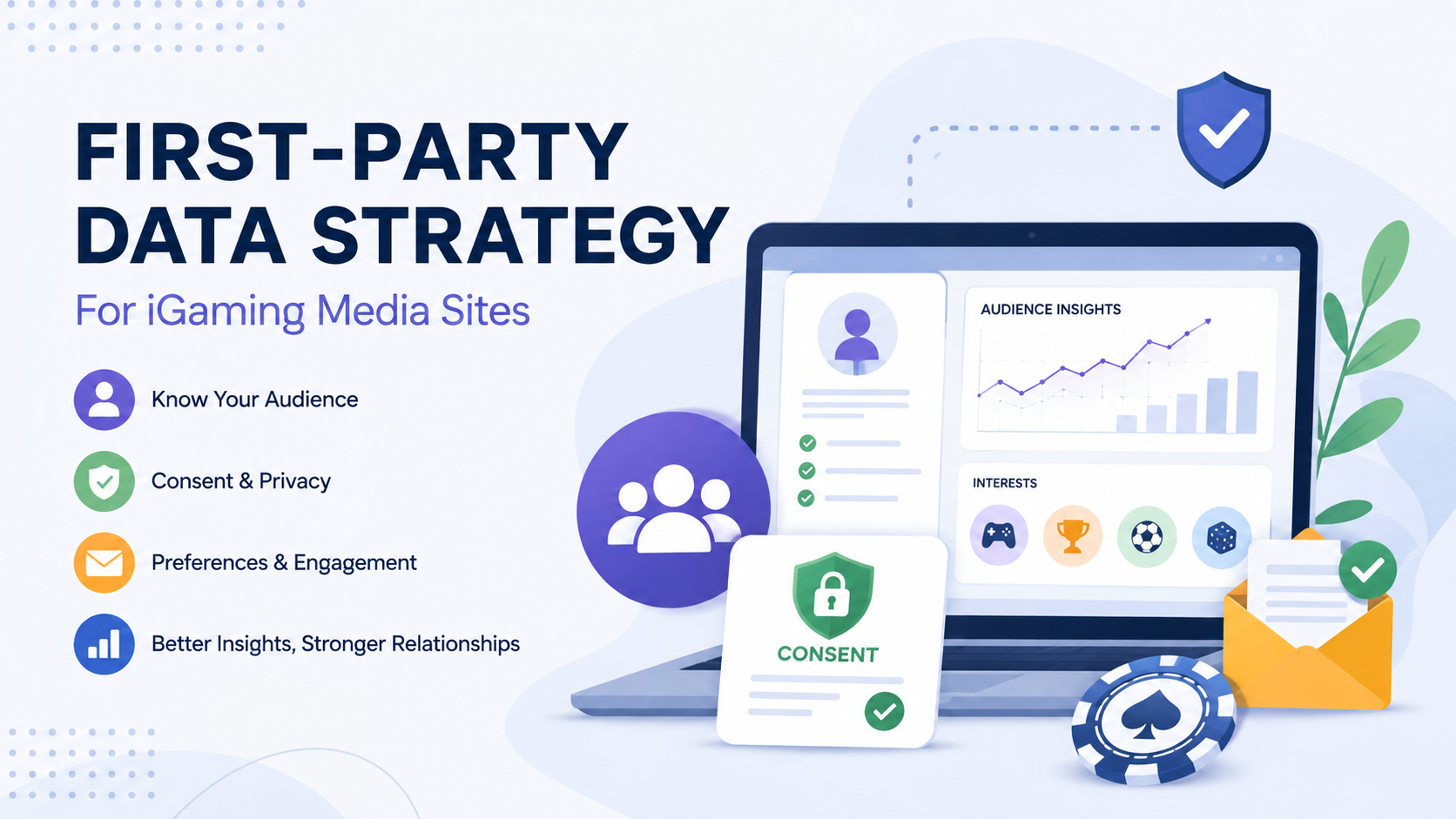
Third-party tracking is becoming less reliable for publishers, while user privacy and data protection laws are getting stricter and more rigorous. For iGaming media sites, this trend is particularly important because audience data can indicate gambling-related interests and therefore needs to be handled with care. One solution is to utilise a first-party data strategy built around consent and valuable content to strengthen engagement and long-term relationships with users.
The article below will explore how iGaming sites can benefit from collecting and storing first-party information and what data they may use to meet their analytics needs and comply with privacy regulations.
First-Party Data Strategy: Quick Overview for iGaming Media Sites
| First-Party Data Type | How It Is Collected | How Publishers Can Use It |
| Newsletter preferences | Newsletter sign-ups | Send relevant news and topic updates |
| Account data | Voluntary user registration | Manage accounts and registered-user experiences |
| Content preferences | Selected or subscribed topics | Recommend more relevant content |
| Survey responses | Surveys and questionnaires | Understand audience interests and content needs |
| Preference centre choices | User-selected communication settings | Personalise newsletters and communications |
| On-site engagement data | Searches, categories viewed, and content interactions | Measure content performance and audience interests |
What Is First-Party Data and Why Does It Matter for iGaming Publishers?
First-party data is information about an audience that a publisher collects directly through its own media resources, such as a website, app, newsletter, or registered user account. In most cases, this includes subscription data, account information, stated preferences, likes and dislikes, survey responses, and other information that users provide or generate while interacting with the publisher’s platforms.
For iGaming publishers, this information is particularly valuable because it provides direct insight into their audiences without relying entirely on third-party identifiers. The more relevant data points a publisher has about its audience, the more opportunities there are for useful segmentation and analysis.
A direct connection with users can also help publishers understand their interests across different areas of the iGaming industry, including regulations, responsible gambling, technologies, and other topics. These insights can help publishers understand what their readers are interested in and make better decisions about the content and communications they provide.
Collecting information directly can also give publishers greater control over how audience data is collected, stored, and used. IAB Europe has highlighted the importance of first-party data for publishers as the digital advertising ecosystem moves towards more privacy-focused approaches.
For an iGaming media site, the value therefore goes beyond simply having more audience data. A well-managed first-party data strategy can support better audience understanding and stronger relationships with readers, while also placing greater responsibility on the publisher to protect the information it collects and use it appropriately.
Build Voluntary Registration Opportunities
Registration can become one of the pillars of any first-party data building effort, but the value exchange has to be carefully engineered so that it does not rely on hard-selling methods or demanding too much information in return for the value provided.
An iGaming media house can offer its newsletter, personalised articles or research reports and updates on relevant regulations as an exchange for the data, but the amount of information requested should not surpass the needs of the publisher.
If someone wants to subscribe to the newsletter, asking for their email and preferred topics is enough; there is no need to request multiple pieces of information that the publisher will not utilise.
Therefore, the registration form should be short and only include the necessary contact information. In addition, it is vital to let the users know that they will be able to choose what content they wish to receive via email or make the selection themselves.
This approach also follows the principle of data minimisation, under which personal data should be adequate, relevant, and limited to what is necessary for its stated purpose.
Use Content Preferences as Signals
Readers’ engagement with particular types of content can generate useful information about their preferences without employing invasive behavioural profiling. For example, the popularity of news items related to regulation can signal the target audience’s interests and enable recommending similar articles through newsletters.
In this respect, publishers can utilise the categories browsed, subscribed to, searched for, or selected by users, applying generalised preference models based on their own first-party data.
Similarly, aggregated and processed data, partially reliant on behavioural information, can be utilised on the servers with limited access for other parties. Particular caution should be exercised with data related to gambling.
Lastly, targeting users by context is an optimal choice for many publishers to avoid excessive personalisation. According to recommendations provided by IAB Europe, contextual targeting can provide an alternative to advertising based heavily on individual user profiles.
Make Consent a Core System
The cookieless strategy is not intended to encourage data collection without consent. In particular, the elimination of third-party cookies is not an end in itself.
The ICO guidance on cookies and similar technologies explains that organisations using cookies and similar technologies need to provide users with appropriate information about their purposes and obtain consent where required.
For publishers subject to UK data-protection rules, consent mechanisms for non-essential cookies and similar technologies must meet applicable standards for valid consent. Publishers operating internationally should assess the requirements applicable in each jurisdiction.
In addition, the guidance underlines the importance of informed and positive consent for businesses.
Publishers operating in multiple jurisdictions, therefore, should make consent management a priority. This involves designing the data collection strategy around the regulatory frameworks relevant to the regions where they operate and providing users with greater transparency about the data collected.
Create a First-Party Audience Database
Once first-party data has been collected with the appropriate permissions, publishers need a central system where useful audience information can be organised and managed. Instead of keeping registration data, newsletter preferences, survey responses, and other audience information across disconnected systems, the publisher can bring relevant data points together in a first-party audience database.
The database should contain only the information the publisher actually needs, such as account details, newsletter status, declared content interests, consent status, and relevant engagement information. Each data point should have a clear purpose, and access should be limited to the teams and systems that need it.
Publishers should also keep the database accurate and up to date. If a user changes their preferences, withdraws consent, or closes an account, those changes should be reflected in the systems using that information. In this way, the database becomes a controlled source of audience information rather than simply another collection of user identifiers.
Develop Preference Centres
Preference centres let readers choose the topics and communications they want to receive, giving publishers explicit audience signals while making the experience more relevant, thus turning privacy management into a relationship-building opportunity.
It helps to make the experience more relevant for the users, so that they feel like their time is spent wisely, and it also helps to get more honest data on user preferences.
For instance, if a user wants to receive regulatory news but does not want to subscribe to other categories or promotional campaigns, respecting that choice can improve the user experience while giving the publisher a clearer understanding of what that reader actually wants.
In addition, a preference centre can provide more relevant data because users explicitly choose and share their preferences.
Use Surveys and Interactive Content
Surveys enable publishers to obtain information that cannot be derived from any other source. Readers will provide information on the topics, formats, and trends of interest to them.
Interactive explainers, quizzes on regulatory topics, and research questionnaires can elicit first-party signals if the methodology is disclosed, and the collection process is fair.
The most critical recommendation is to disclose the reasons for conducting the research since honest responses are likely to be provided by those who understand the purpose and how their answers will benefit the organization.
Explore Privacy-Safe Data Partnerships
First-party data does not mean the publisher is an island. Industry voices have proposed solutions such as data clean rooms or limited second-party partnerships, which would allow organisations to collaborate while still protecting the privacy of each other’s data.
For media publishers, iGaming data partnerships are an opportunity, but one that should be cautiously embraced. Data sharing agreements should be carefully negotiated and include terms of use, consent, and control over the other party’s data matching and sharing capabilities.
A publisher should not exploit a data partnership to work around privacy laws. Data alliances should be formed for a legitimate purpose, such as audience measurement or commercial analytics, and should be underpinned by appropriate oversight and control mechanisms.
Measure Quality, Not Just Volume
A large database is not necessarily a valuable database. Publishers are right to be thinking about value, accuracy, permission, and utility in their database.
Instead of looking at these factors separately, publishers can track them through a small set of first-party data metrics:
| Metric | What It Measures |
| Registered users | Growth in the number of users who have registered directly with the publisher |
| Newsletter sign-ups | Growth in users who have chosen to receive publisher communications |
| Preference centre completion | The number of users who have actively provided their content or communication preferences |
| Consent rates | The percentage of users providing the required consent for relevant data uses |
| Data recency | How recently audience information and preferences have been collected or updated |
| Profiles with meaningful declared interests | The percentage of audience profiles containing useful interests explicitly provided by users |
This approach to metrics is smart because it moves away from the idea of chasing as many identifiers as possible, focusing on narrower audiences who have demonstrated a higher level of engagement and interest.
Protect Sensitive Audience Context
iGaming media outlets have to operate in the environment of privacy-conscious and responsible audiences. Information about users’ preferences related to gaming activities should be handled carefully rather than treated like an ordinary marketing data asset, as there may be additional ethical, privacy, and regulatory considerations to take into account.
First of all, data minimisation, access control, retention standards, and internal governance must be implemented on the publishers’ side, as well as separation of concerns between editorial analytics and user data monetisation practices at any stage of processing.
Moreover, first-party tracking should not be used as a means to reproduce the third-party tracking infrastructure’s capabilities, as technical research has shown how first-party tracking is used across the web to facilitate third-party surveillance.
Prepare for a More Fragmented Web
The cookieless transition is not something that will be standardized in a particular moment. Browsers, platforms, and regulators have diverse and often conflicting requirements for tracking and measuring audiences.
Google’s Privacy Sandbox is another reminder of the instability of technical solutions in this area. In October 2025, Google announced that it would retire several Privacy Sandbox technologies after evaluating industry feedback and their low levels of adoption. However, Google did not abandon the entire Privacy Sandbox initiative: technologies including CHIPS, FedCM, and Private State Tokens continued to be supported, while Google said it would continue work on other privacy-related standards and technologies.
In other words, the changes showed why publishers should not become overly dependent on technical solutions before they gain sufficient adoption and market stability.
Contextually, publishers should make the most of the opportunities by preparing multiple solutions for measuring audiences as a way to hedge against the risk. Ultimately, as iGaming media companies prepare for the cookieless future, having several different options for first-party data, consent, context, analytics, and flexibility will make them less dependent on any one particular supplier.
The Long-Term Advantage
The most valuable asset of an iGaming media site in a cookieless world is not going to be another identifier designed to replace the third-party cookie. Its most valuable asset is its audience.
Having first-party data means that publishers can establish strong, lasting relationships with their audiences and create fit-for-purpose measurement ecosystems to complement their engagement models, but only if they stop thinking about another cross-site measurement solution and start thinking of solutions that are based on openness, balance and mutual benefit.
Publishers that embrace consent management and use context and data to help understand their audiences are going to be best positioned to thrive in the new ecosystem. And for iGaming media sites, it means focusing on relationships rather than on data: instead of first-party data as a bridge to cross-site tracking, think of trust as the foundation for building long-term loyalty.
Frequently Asked Questions (FAQs)
What is first-party data in iGaming?
First-party data in iGaming is information collected directly by a publisher or business through its own website, app, newsletter, accounts, surveys, or other owned channels. It can include subscription information, declared preferences, account data, and other information provided directly by users.
How can iGaming publishers collect first-party data?
iGaming publishers can collect first-party data through voluntary registrations, newsletter subscriptions, preference centres, surveys, interactive content, and appropriately managed website or app interactions. Publishers should collect only the information they need and follow the consent and privacy requirements that apply to them.
What is the difference between first-party and third-party data?
First-party data is collected directly by a publisher from its own audience, while third-party data is obtained from outside organisations or sources that do not have the same direct relationship with the publisher’s users.
Can publishers use first-party data without cookies?
Yes. First-party data can be collected through methods such as registrations, newsletter subscriptions, preference centres, and surveys without depending on cookies. However, using cookies or similar technologies to store or access information on a user’s device may still be subject to consent and other applicable requirements.
Why is first-party data important for iGaming media sites?
First-party data gives iGaming media sites direct insight into their audiences, reduces their dependence on third-party identifiers, and can help them understand users’ content preferences. It can also support stronger long-term audience relationships when the information is collected and managed responsibly.
