

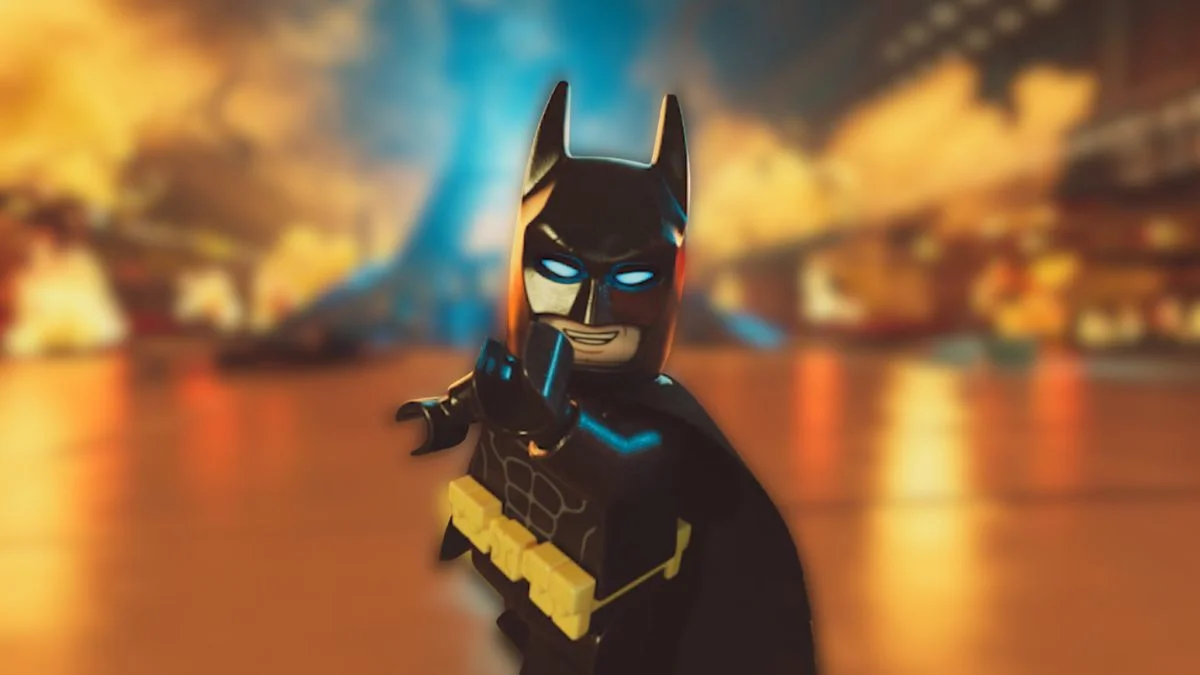
Think of a Lego set built around Batman 89, the Tim Burton movie that helped define the modern superhero blockbuster. Now imagine even more sets for Batman Returns, Batman Begins, The Batman and more. You take pieces from each set and put them back together. In the beginning, you can still identify chunks from individual movies, but the more you mix them, the harder they are to identify. Eventually the line between one and the other seems almost impossible to find. That’s the feeling of playing Lego Batman: Legacy of the Dark Knight, a game that spreads its references so liberally that the mix becomes its own world. It feels its way to the golden age of licensed Lego games; for the first time in years, that feels genuinely new.
That freshness kept pulling me back during my entire time with Legacy of the Dark Knight. I started with Lego Star Wars like many gamers. The Video Game, the 2005 Traveller’s Tales release that set a house style for the Lego series and launched a wave of licensed adaptations. I was hooked, spending hours trying to uncover every secret and unlock every character. It was a simple game with secret bonuses and a funny take on a universe that really mattered to me.
But over time, the licensed Lego formula became dangerously saturated. At its peak, three or four licensed entries would drop in a single calendar year, and the series ran itself into the ground. There is only so much hidden collectable hunting one can do. Licensed games have become far rarer, with Lego more recently moving towards more artistically minded projects like Lego Builder’s Journey or Lego Voyagers. In that context, Lego Batman: Legacy of the Dark Knight feels like a calculated statement. This is the kind of direction a Lego game can go if given enough time and attention.
The Legacy of the Dark Knight is, loosely speaking, an original story stitched and reassembled from the narratives of countless Batman properties. These borrow most heavily from the many film adaptations and reboots and also from recognisable comic storylines and at least one significant video game touchstone. The characters have shown up in various adaptations, so the game includes some light reasons for how they change over time. Jack Napier is a small-time crook who puts on the Red Hood and falls into a vat of chemicals, but he was always a cruel guy who liked to torment the people around him, and in this version he even came up with the Smilex poisoning scheme before the toxin got to him. The Penguin starts out as a street-level thug plucked from the Batman universe before becoming a mayoral candidate with animalistic tendencies straight from Batman Returns. There are plenty of other unexpected turns waiting for you to discover.
The game copies and remixes so many beloved movie sequences that it invites comparison to the originals. There’s something really weird about hearing classic lines from new voices. Jack Nicholson’s Joker dialogue is burnt deep into memory, so hearing a fresh interpretation, one designed to accommodate the character’s various transformations, lands just slightly sideways. You can’t blame the actor – who does the material proud – but it’s a tough ask for any actor to return and deliver some of the most iconic dialogue in superhero film history. Sometimes the story can also feel a little loose, trying to force together two film plots that weren’t made to connect. It is often played for comedy and holds together well enough that the tone indicates the writers are fully aware of what they are doing.
Running through all these moments, the story keeps its attention on assembling the Bat-family, framing that as the truest piece of Batman’s enduring legacy. Each chapter revolves around bringing a new crimefighter- Robin, Batgirl, and others into the fold and learning the mechanics they bring to combat and puzzle-solving. You always control Batman with one partner beside him. You and your secondary character can be swapped freely in most situations. This structure keeps the cast deliberately tight, a meaningful departure from the enormous rosters in earlier Lego titles that resulted in grouping characters by type. Jim Gordon carries two specialised weapons, one launching sticky adhesive and another firing a ricocheting projectile, and those tools belong to him alone. Batgirl is the sole character capable of hacking terminals, Robin forces open weak points using his bo staff, and the pattern continues throughout.
Lego games are all about collecting, and this one is no different. Instead of an endless list of things, you earn currency to unlock new costumes for your main crew, colour schemes that can be applied to any costume, upgrade materials and decorative items for your home base. Everything loops back into itself in a nice way, and I constantly found myself stopping at the in-game shop to pick up new outfits. As a Batman fan and a Lego fan, there’s something endlessly satisfying in seeing how different suits manifest in this visual style. The game packs in uber-specific shoutouts to certain comic storylines, as well as costumes from every major film and TV adaptation you can recall. Getting all the droids in a Lego Star Wars game didn’t excite me much, but the chase for every deep-cut Bat-suit here feels truly compelling.
Legacy of the Dark Knight also pays strong homage to Rocksteady’s Arkham universe, drawing most directly from that as the structural foundation for its moment-to-moment gameplay. The familiar form of the famous Arkham combat is back – the same basic cadence of strikes, dodges and counters, augmented with gadgets as your kit evolves. Things slow down a little, but as the crowds get bigger and the combo count gets higher, it starts to feel a bit like an Arkham title running on a Lego visual layer. It lacks some of the bite and nastiness of the Rocksteady originals, especially with the more restrained gadget choices, but it nails the essential feel of Arkham’s rhythmic combat.
That said, the Arkham parallel shouldn’t be overstated; the combat here doesn’t reach that level of polish. This is Arkham Lite, not a real continuation of what Rocksteady built. Even so, just a little of that design philosophy goes a long way, making the fighting that much more interesting than the combat in traditional Lego titles and proving that even a little of that influence can go a long way towards making a game feel alive.
Moving through the open world of Gotham feels much the same. At any time, you can call up your favourite Batmobile from the entire history of Batman’s vehicles. Most are quite similar, able to destroy straightaways and negotiate tight corners, but meaningful differences exist where appropriate. The Nolan Tumbler has a heavy, tank-like quality that is the antithesis of the light, agile feel of the Batman 89 version. But in practice, the quickest way to get from point A to point B is to grapple to the nearest high point and go into a glide that takes you over large sections of the city. It never quite reaches the elegant flow of the Arkham games, but it’s not as far off as you might think.
The one area where the Arkham parallels really don’t hold up is stealth. Those games were lauded for putting you in the position of being Batman the hunter, not the hunted, with terrified criminals as your target. The stealth in Legacy of the Dark Knight is serviceable but nothing special. There are quiet takedowns, but there are limited tools to rattle an entire room or to disappear once detected. I often found myself killing a couple of enemies, getting spotted, and fixing the problem in simple combat instead of cleanly clearing rooms. It’s a glaring omission for a game that otherwise does a fantastic job pulling from what are widely considered the best Batman games ever made.
From that solid base, the Legacy of the Dark Knight gets its variety without going down bloated territory or padding itself with underdeveloped characters and systems. Gotham’s open world is filled with hidden caches, Riddler and Cluemaster challenges, AR combat and racing tests, crimes to interrupt, and small environmental puzzles associated with fast-travel points. Even within missions, the action is constantly shifting; combat gives way to puzzles, which give way to platforming, which gives way back to combat. The main campaign moves at a confident pace and gives you plenty to chase, and Gotham itself is rewarding if you just want to wander around and find things.
I was switching between a few allies and skills, and I was glad to see a sonar ping that is very much like Arkham’s Detective Vision, showing things to investigate. Sometimes you need this to inspect clues or follow footprints, but it just shows you the way ahead too. I’ve felt so stupid playing other Lego games thinking I was missing something obvious that was preventing me from progressing. That frustration was never a problem in Legacy of the Dark Knight, because the ping was always there to indicate what was important. Most progression blockers are about taking specific things and breaking them into something useful, so the ping helped me know what to break and what could actually be broken.
The stud-multiplier system adds a further element of decision-making, which may have been present in earlier entries, but if so, had never registered with me. Whereas in previous games multipliers were just passive unlockables, Legacy of the Dark Knight turns it into an active build-up metre that slowly depletes. This adds a little more consideration to your standard destruction, as the timing of your approach around a high-value stud suddenly matters. That’s another way the game adds a bit of depth to itself – nothing too much or out of place in a Lego title, but enough to keep the attention of older players.
This is very much a game for adult fans who have real knowledge of Batman’s long cinematic history. Batman himself remains true to his stoic persona while also working as a Bugs Bunny-like mischief figure. Sprinkled throughout the reference-heavy narrative are nods as diverse as It’s Always Sunny in Philadelphia to Street Fighter 2. The writing is sharp and often laugh-out-loud funny, with a good sense of comedic timing and visual gags that have real cinematic energy.
Beneath the jokes, this is a game that believes time is important. As the story develops and as Bruce experiences different stages of his life and new relationships with the people around him, he visibly ages. The legendary Bat Cave transforms from a simple rock with a few terminals to a huge technological installation that monitors your progress and that you can customise in many different ways to reflect your own priorities.
Lego Batman: Legacy of the Dark Knight is, in a very broad sense, a game about time and the things it changes. Lego games broke big with Lego Star Wars over twenty years ago, and somewhere along the way the series lost its identity and became a franchise factory. Legacy of the Dark Knight set the ship right by returning to basics: sharper writing, tighter focus, and mechanical complexity measured out precisely. It feels like the series has rediscovered itself for the first time in a long time. It’s still there, just not quite as frictionless. There’s a lot more to discover. And it’s another sweet, funny spin on a mythology that really counts. It’s the most fun Lego game since 2005 and a genuine model for how the series can reassemble itself into something worth playing, one piece at a time.
Also Read: GTA 6 At 30 FPS On Consoles: Is It Actually A Problem?
