


Suppose you have made a $50 bet on a football game. Your team loses in the closing minutes. You are mad but instead of closing the betting app you place another $100 bet.
You lose again, this time.
Now you are no longer thinking about entertainment. You are thinking about getting your money back.
And that is where emotions can start to change the way that a person gambles.
People don’t always make gambling decisions by looking at odds or probability. Winning is confidence for a person. Loss can be frustrating or angering. Stress can make gambling seem like an escape and lack of interest can make a person stay longer than planned.
These feelings do not automatically mean that someone has a gambling problem. But when feelings start to drive how much, how often or why a person gambles, it can be a much harder situation to manage.
What Is Gambling Emotional Decision-Making?
Emotional decision-making is when your emotions make you gamble more than your original plan.
A person might, for example, decide before they start betting that they will spend $50. They may be saying, having lost that much:
Another bet and I’ll get it back.
The next bet is no longer about entertainment. This is about fixing the loss earlier.
The same can happen after a big victory.
A player plays from 100 to 300 and starts to feel good. They bet more because they think they still have their luck. They may continue when they wanted to stop.
In either case the outcome of the previous bet is affecting the next choice.
Why does gambling evoke such emotion?
Gambling sessions are full of activity.
Before a result there’s the thrill, the loss of disappointment and the instant rush of victory. People may already be rooting for the team they are betting on, so sports betting can add to the excitement.
A last-minute goal, a missed penalty or a late comeback can turn an ordinary bet into an emotional experience.
Near misses can also feel different from regular losses. It was still a loss, but a person might think they were “so close” to winning.
Research into gambling behavior has identified links between the way people understand gambling outcomes, beliefs about control and gambling-related cognitive distortions. Such considerations may affect decisions later.
The important thing is simple: how a person feels after one bet can affect the next bet.
Chasing Losses: When One Bet Becomes Another
One of the prime examples of emotional gambling is chasing losses.
Usually starts with a simple thought:
“I’ll get it back.”
Someone loses $100 and then makes another $100 bet. That bet loses too, so they raise the amount again.
The original $100 loss was maybe manageable. Trying to get it back can make it a much greater loss.
There are stories like this in real gambling communities.
A 25-year-old gambler turned a €50 casino deposit into €100,000 within a week but lost the entire amount in just 10 minutes through high-stakes roulette bets. Looking back, they realised that greed, excitement and losing perspective on the value of money kept them gambling even when they had already won life-changing amounts.
Lost €100,000 in 10 minutes
by
u/AskComprehensive9797 in
problemgambling
Their story is a warning about chasing bigger wins and not knowing when to walk away.
These are personal experiences, not scientific evidence. But they show how fast thinking can change:
After winning such a large sum from an initial stake of just 50 euros, he could have stopped; however, his greed wouldn’t let him. Consequently, he lost not only his winnings but also the original amount he had wagered.
That is the emotional snare.
What Happens After a Big Win?
It’s not just losses that can change behavior.
Winning can do it as well.
A sudden increase in confidence may come to someone who wins a substantial sum. They might begin to think they have a feel for the game or are on a lucky run.
The thoughts can go like:
I am on a winning streak.”
“I can take bigger risks.”
“One more win and I’m done.
But a win doesn’t make the next outcome any more probable.
That can happen very quickly, as a Reddit post from 2023 shows. One user said he started out playing baccarat and lost money and then won about $70,000. Instead of stopping, they tried to win even more and lost a big chunk of that later.
The lesson is not that winning is bad. It is that a big win can also change a person’s attitude towards risk.
Anger also makes people more likely to take risks
Sports betting provides an easy example.
Imagine your team is winning for most of the match. You have placed a $50 bet. In the final minutes, the other team scores and your bet loses.
Listen if you are angry.
You immediately place another bet to make up for it.
This is commonly called betting on tilt. You’re making the decision when emotions are running high, not from the plan you had before the game.
One recent Reddit discussion was about a person who got very angry after losing and kept putting more money in after losing repeatedly. The person also remembered thinking that the previous wins would help them win back the losses eventually.
That combo can be dangerous:
Loss, anger, bigger bet, another loss, more anger.
The sum can build up before the person has had a chance to stop and think about what they’re doing.
Gambling When You Are Stressed or Bored
Emotional gambling does not always start with a bet.
Sometimes it begins with a feeling.
There is a guy who is not financially strong and wants to become rich in an easy way, so he opens a betting app. Someone else is sitting at home bored and plays a casino game because they have nothing else to do.
The problem is when gambling becomes the main coping mechanism for those feelings.
When people start thinking, “I have to gamble because I’m poor,” gambling stops being entertainment.
Problems with gambling have been linked to emotional distress, gambling-related thoughts, and gambling-related decision making.
A good question to ask is:
“Am I gambling because I want to or because I want to change the way I feel?”
That little question can tell you a lot.
The Psychology of Risky Gambling
Several common thinking patterns can affect gambling decisions.
The Gambler’s Fallacy
It’s been a few times that a roulette wheel will come up black.
Player’s thoughts:
“Red’s got to come now.”
When folks are playing roulette, saying “red’s got to come now” means that red hasn’t shown up in a while, so the player thinks it’s about time for it to hit.
But the earlier results are no assurance of the next result.
Chasing Losses
“I’ve already lost $200. “All I need is one good bet to get back to even.”
The previous loss is the reason for the next bet.
Illusion of Control
A player believes that knowing a particular team, player or game gives them more control over the final outcome than they really have.
Overthinking
“I have already lost so much tonight. I can’t stop now.”
The money already lost cannot be recovered by continuing. Yet the amount already spent can make stopping feel harder.
Overconfidence After Winning
“I have won three bets in a row, so I know what I am doing.”
Previous wins do not guarantee the next result.
These thoughts can feel completely logical in the moment. That is what makes them difficult to notice.
What Real Gambling Experiences Tell Us
Comment
by
u/mcliquor from discussionin
AskReddit
One Reddit user, bigmur72, shared a wild gambling experience from Atlantic City after spending hours drinking and playing craps. He lost around $1,000 through several ATM withdrawals, but decided to give gambling one last try with $200 at a blackjack table.
Surprisingly, he turned that final $200 into around $600 after hitting three blackjacks on a split-aces hand. He ended the night with more money than he had started with, tipping the dealer before stumbling back to his room and passing out with the cash spread across his bed.
One Reddit user shared how a small gambling session quickly turned into a serious loss. They started with 200 and managed to turn it into 3,500, but instead of cashing out, they kept playing because they thought they could double it. After losing the money, they started gambling again to win it back, eventually using their savings and credit card.
After several rounds of winning and losing, the total loss reached around 20,000. The user said they could not sleep for three days and felt completely overwhelmed by what had happened. What started as an attempt to make extra money to pay off loans ended up causing even more financial and emotional stress. Their final warning was simple: “Don’t ever try gambling.”
I don’t regret losing $1.2 Million.
by
u/FoxBeginning9831 in
problemgambling
One Reddit user shared their experience of losing around $1.2 million over 30 years of problem gambling. For years, they regretted every loss and kept returning to gambling because they wanted to recover the money they had already lost.
They eventually realised that they were not just chasing the losses from one gambling session. They were trying to win back their entire lifetime of losses. The user said they finally stopped gambling when they accepted that the money was gone and stopped blaming themselves for it. For them, not gambling became a way of seeing how much money they were saving and moving forward with their life.
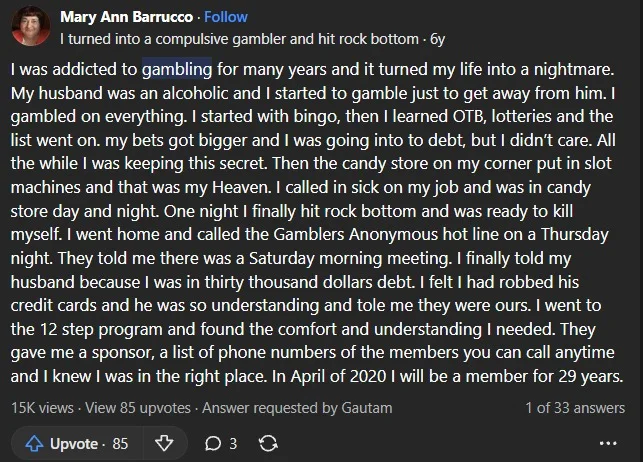
I also saw many reviews on Quora where people shared their own experiences and talked about how their experience was like.
This article is not promoting gambling in any way. I am only sharing it to provide information. You can read it, learn from it, gain knowledge, and understand many other things from these experiences.
How to Keep Emotions Out of Gambling Decisions
There is no way to remove uncertainty from gambling. But there are ways to make emotional decisions less likely.
Set Your Limit Before You Play.
Before you start, decide on a budget and the amount of time you are willing to spend.
Don’t raise that limit because you’re losing.
Don’t Chase
You have lost someone already. Another bet doesn’t increase the chance that the previous loss will go away.
Take a rest
Take a break if you are angry, frustrated or desperate to win.
It’s normally easier to make decisions when the emotions have died down than to make them during a stressful session.
Keep a Log
Record wins and losses and deposits.
This will help you see the bigger picture, not just the exciting wins.
Utilize gambling controls
Depending on where you live and the gambling service you use, tools such as deposit limits, time-outs, cooling-off periods and self-exclusion may be available.
These tools can buy some time between an emotional thought and the choice to gamble.
The Main Difference Between Gambling and Emotional Gambling
Getting into a game or a casino game or feeling excited about a match does not mean that someone is gambling irresponsibly.
The bigger question is, does the emotion start to change the behavior of the person.
They could both lose $50.
You close the app and jump on.
The other person gets mad and they immediately put another $200 in to get their $50 back.
The loss is the same.
The reaction is very different.
And that reaction is often where the importance of emotional decision making comes in.
Note: The psychological aspects discussed in this article are based on research into gambling behavior, emotional regulation and cognitive distortions. Studies have examined the connection between emotion regulation and gambling disorder, while research has also explored behaviors such as chasing losses, gambler’s fallacy, illusion of control and near misses in gambling. Information about the wider health and social harms associated with gambling is also supported by the World Health Organization, which outlines the potential financial, mental-health and social consequences of gambling.
Also Read: 25 Red Flags of an Unsafe Online Casino: How to Spot a Scam Before You Deposit
