


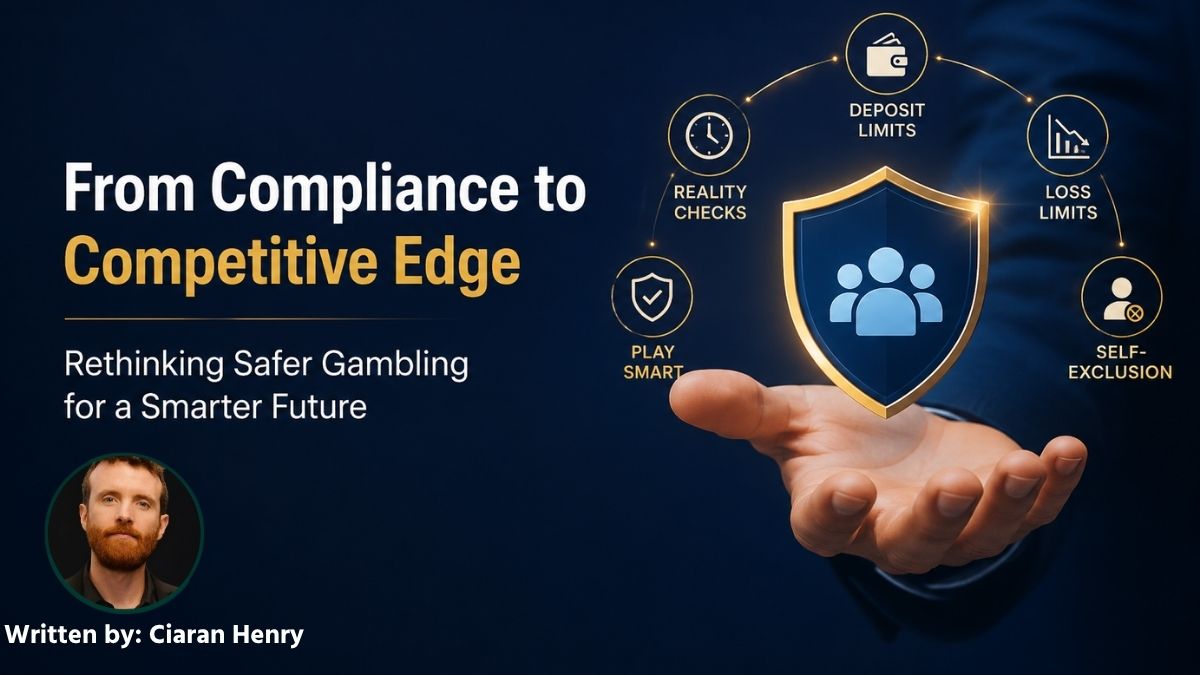
Safer Gambling tools have been in use for years so why do they still seem so basic on the majority of platforms? In this piece, we are introducing a person who has spent 15+ years building these things from the inside. He breaks down why poker players have always expected and gotten far more control over their own play than casino or sportsbook customers typically do and makes a strong case for why player protection should be treated as a business advantage, not a compliance checkbox. We are grateful to share his insight here at iGamingXP.
This article is a culmination of two things that have been on my mind recently:
- Lately I have received increased engagement due to my last Deposit Limit article and the information I shared. This is surprising as none of what I wrote was innovative or revolutionary (to me atleast)
- In the past two weeks, I’ve seen a big increase in content regarding SG in-client systems and how they are viewed by Stakeholders.
“POKER ISN’T GAMBLING” (well… not really)
This is one of the most hotly debated and contentious takes in online gambling. Where you stand on this is entirely upto you and everyone’s mileage will vary.
The reason I bring it up, though, is that, from what I have seen over my working life, Poker players behave differently than other punters when it comes to their expectations [of an operator].
Allow me to explain:
The online poker community knows that Safer Gambling mechanics and technical systems have been around for years.
That’s right:
- Deposit Limits.
- Loss Limits.
- Reality Checks
- Max Wager Limits
- Self-Exclusions
None of these are NEW.
As far back as I can recall and probably even before I ever got into the industry, there have been RG/SG Features (I don’t like the term ‘SG/RG Tools’) available within game clients. When I started in FTP in 2009, ‘self-exclusion’ mechanics were already in full swing and were widely* used by a portion of the customer base.
On PokerStars and Absolute Poker too, use of rudimentary SG systems was common enough. With the advent of regulated markets, like France & Italy, player protection mechanisms became mandatory requirements for licensing. Usage naturally followed suit.
But here is the crux: amongst sportsbook users and Casino players, from veterans of those fields, customer uptake was/is low (by comparison to poker players)
Why?
Well, I have a few theories but nothing concrete or solid enough for me to publish. One possible reason, though, is customer expectations. Poker players expect more for their money. They seek a better user journey. They see their vertical as more polished and cerebral than Casino or Sportsbook.
It’s simple enough to understand in Poker, you can influence what happens. You have much more command over the behaviors and outcomes of each hand. By contrast, in casinos & sportsbooks, you are an observer* and witness the outcome with little to no input on how things shake out (a big oversimplification, I appreciate).
“Please restrict my account so I can only play HUHT on Wednesdays between 2pm and 4pm, but only against micro-stake players who don’t have numbers in their Player IDs. Thanks.”
The above is an example of a common enough request that customers would send to my former team. Certain players would expect such a high level of admin control and customization from us [‘WeCare’] that they thought we could build one-off restrictions just for them.
These kinds of requests perfectly encapsulated one of my famous lines (and a soundbite I am known for from within the industry):
“…tailor your own gaming experience…”
While it’s true that my former employer could offer players a lot of personalization and customization, the above is just ridiculous.
But what about something more practical:
‘Please block my account from anything above 0.25/50 for 30 days & completely disable Spin&Gos.’
or
‘Set a monthly deposit limit of $50 so I can test my skills and try to build my bankroll. I’m player, so can you also shut-off MTTs and CASH?”
All very double and straightforward.
Why would players want these?
“Well clearly it’s because they are suffering Gambling Harm…”
…someone said to me during a presentation I gave in my last company.
“NOPE”
It’s because they were paying customers and wanted to tailor their own gambling experience towards just the formats they enjoyed (actually used) and wanted nothing to do with the variants they didn’t like.
I do this myself all the time.
Whenever I try out a new site, I check what SG features they offer and I contact CS Support to see what they can offer me. If they don’t have the ability (or won’t) block CASH games, then I simply won’t play there.
This is not because I have some harm-related susceptibility to Cash games. It’s because I’m rubbish at them and want nothing to do with them.
I am, potentially, a paying customer after all. Why shouldn’t I expect more for my customer?
Looking across the sector, I rarely see the same feasibility in Casino or Sportsbook providers.
Is it because the operators don’t want to do this or is it because customers don’t look for it?
I’m sure if I asked for an extra boost on my ACCA or a free bet I’d get it but what about being asked to be blocked from Slots or to have horse racing removed from my UX?
“Try our Safer Gambling tools”
“These help you stay IN CONTROL and IN THE GAME.”
Ah, bless…
The above is a paraphrase of a few different sports betting companies here in Ireland/the UK.
They have switched their outreach comms now to promote safer gambling and I really do think that’s a step in the right direction, but few [companies] offer anything unique or special to the public.
In fact, alot of larger outfits only provide rudimentary versions of the same handful of mechanics expected by their licensing body:
- Deposit Limits (Often Dropdown or Zero-Point)
- Reality Checks (Akin to a Stop Watch)
- Time-out & Self-Exclusion (frequently listed as separate offerings to imply more options)
I did a quick check across 8 of the largest UK/Ireland-based businesses for reference.
In comparison to what you can avail yourself of in poker, does this not seem a bit cheap?!
Sure, you sometimes find the option to set ‘Loss Limits’ & a ‘Bet Calculator’ to help manage your spending and ensure you never lose too much but really, is this the best the sector can offer?
When I worked at PokerStars, Casino games and Sportsbook would become fully integrated parts of the business (all 3 could be accessed via the game client). As such, the edict came down that these verticals should have the same* functionality as the Poker platform.
That’s right, folks; now not only could people/users set ‘Reality Checks’ and ‘Deposit Limits’ [INPUT FIELDS] but they could also voluntarily assign their own thresholds for separate casino variants and a max spend/stake cap for betting.
Imagine as a customer being able to regulate individual game types to suit your particular playing style & preferences?
Consider yourself an operator; promote to your customer base that not only does XYZ Bet offer the same basic entry-level options (that everyone else does) but also more creative features that empower you to prioritize the game you enjoy (and potentially are most profitable at) and can be protected from those you suck at!
What I’m talking about isn’t novel new features for the sake of it. This is not vapid-dressed innovation just to brush up some headlines and hype.
What I’m trying to get at is this: iGaming is an incredibly saturated marketplace, and gaining genuine (& ethical) competitive edges is rare (often short-lived too). There are frequent announcements and PR carousels about this new AI Implementations and Ground breaking Insights to help stem Gambling Harm yet actual player-assessable features to assist remain very Generation One. I wish to challenge this paradigm.
“Choice Paralysis & Customer Confusion”
Have you ever heard about the Jam Study? It’s a genuinely fascinating piece of research that I have been referencing for years.
I won’t spoil it for you but the gist is that ‘offering more and more occasionally causes less and less.’ Now many would argue that more variety and optionality are great for customer empowerment. This can be a double-edged sword, though, when it comes to Safer Gambling features.
To illustrate this, please try out a particular central European licensed ‘gambling site.’
On this specific license, operators are required to provide plenty of options for players:
- Mandatory Deposit Limits (D/W/M)
- Mandatory NET Loss Limits (D/W/M)
- Game-Vertical Stake Limits (Casino, Poker & Sports)
- Number of Total Monthly Logins
- Login Duration (D/W/M)
- Session Time Display
- Accumulative Buyin/Spend Limits (D/W/M)
- Self-Exclusions (incl. ‘Panic Button’)
There are more but I hope you get the idea.
On the face of it, you would imagine that such a plethora of features would be just splendid.
You would be wrong (in my experience).
The friction here is that so many different systems (many of which are obligatory) actually can conflict with each other, frequently causing disruption for the user.
Any would-be customers must navigate these systems and balance them at all times. Operations staff are not permitted to admin-adjust these in any case.
On many occasions, related customers would contact my former team agitated & upset that, unintentionally, they have actually gridlocked their account or restricted themselves in such a way as to make actual gameplay impossible.
With all the best of intentions, so many options caused choice paralysis.
And that’s the real challenge here; implementing variety and accessibility to potential users without overwhelming them.
It’s a very tough equilibrium to achieve (the Goldilocks Zone)
Other licences require multiple mandatory limits and features to assist players so please do not read the above as disparaging towards this specific Gambling Authority. I have the utmost respect for them and the work they do.
“Safety CAN Sell. You just have to believe”
I said at the start of this article that I’ve noticed a very recent shift in the gambling discussion (mainly from the company side) towards adding more user options and accessibility.
While I am one of the biggest voices in this discussion, I am not alone and am welcomely joined by some fantastic thought leaders. This past week, one of these authorities announced that they have been working on a new interpretation of something akin to a Withdrawal System for the UK market. I think it’s an inspired idea and something that the punter public would flock to.
That same person & I have had long discussions over the years about reframing Safer Gambling from a protective (and unfortunately often maligned/stigmatized) perspective to something that can actually attract players. A means of driving business.
Why shouldn’t it be? After all, as a customer, you should be greeted with lots of functions and options to tailor your own gaming experience & play ‘your way.’
- You do not like Casino games? No problem; we’ll disable them for you without any judgment or preconceived assumptions.
- Looking to grind your skills at microstakes? Fair play to you and rest assured, we can lock your account in such a way as to meet your specific wants.
- As a novice blackjack player, do you want to start low and test the waters? That’s what we like to see: sensible gaming so we’ll set a 60-day cap for you.
- A winner at Hockey bets but couldn’t pick a winning horse to save your life? Sure thing, you’re the customer after all, so let’s amend your UX so you only see what you like.
In all other areas of our customer life, we are thought to look for more and expect better from our service providers. Why should not the gambling public do the same?
I believe in PREVENTION before all else. If you Educate, support, and Empower customers at the beginning, then you instill good patterns before potential harm starts.
In this way, not only do you foster a healthy (or healthier) relationship with gambling (in all its facets), but you might also awaken some people to realize, ‘Actually, this is not how I want to spend my money.’
Conclusion
The point here is not that operators need a lot of new Safer Gambling tools. In no way is it about adding features simply to appear innovative. The real opportunity lies in giving customers more meaningful control over how they play.
For years, poker players have expected this level of customization and many operators have successfully delivered it. Yet across much of the wider gambling industry, player-facing tools remain limited to the same handful of standard options. Maybe it’s time to rethink that approach.
If operators genuinely want to empower customers, encourage healthier habits and differentiate themselves in an increasingly crowded market, then safer gambling should be viewed as more than a compliance requirement. Done properly, it can become a better customer experience, a stronger retention tool and ultimately a business advantage.
Safety doesn’t have to be a warning label. It can be a selling point.
Also Read: 25 Red Flags of an Unsafe Online Casino: How to Spot a Scam Before You Deposit
Note: This article is written by Ciaran Henry, a Safer Gambling consultant with over 15+ years of experience working in the online gambling industry. He started his career in online poker before becoming the Global Safer Gambling Trainer at PokerStars, developing and leading player-protection training programs across the company.

