

Learning how to verify online casino fairness is essential for every digital gambler. Manuel Blum published the first protocol for coin-flipping via phone in 1983. His solution was to create a system that would work when two parties do not trust each other and are unable to view the coin, representing a pervasive concern for every digital gambler: how to obtain an even outcome despite distrust and lack of visibility.
For most of the history of online gambling, players had to accept a black box model where trust was placed in a logo at the bottom of a website rather than in the math itself.
Historically, those engaging in gambling via the internet had no certainty of fairness from a website’s operations due to their black box foundations. Rather than trust in any form of maths utilized by a gambling site’s software, they put their faith in a logo located at the bottom of the webpage.
As the internet continues to evolve, so does internet gambling. The industry no longer operates on just one type of operating model but now relies on both traditional institutional oversight models and new cryptographically verifiable algorithms to ensure fair play. Players must first develop an understanding of how a rigged or lucky game operates before deciding whether to trust either model.
How to Verify Online Casino Fairness: Core Trust Models Compared
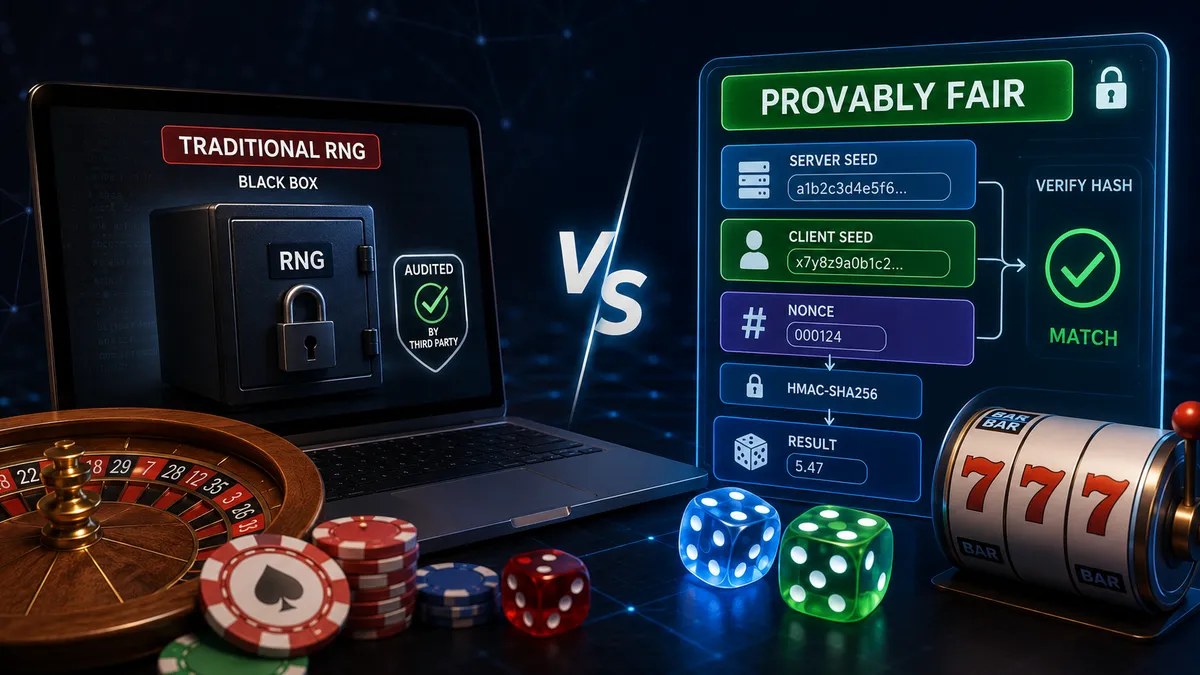
| Feature | Traditional RNG | Provably Fair |
| Trust Mechanism | Centralized (Audit-based) | Player-verifiable (Cryptographic) |
| Verification Timing | Pre-deployment & periodic audits | Per-round (post-result) |
| Verification Tool | Independent Labs (e.g., Gaming Associates, GLI, Tech Labs) | SHA-256 / HMAC-SHA256 Hash Verifiers |
| Input Variables | Server-side only | Server Seed + Client Seed + Nonce |
| Primary Use Case | Complex Video Slots, Live Dealer | Dice, Crash, Plinko, Web3 Games |
| Transparency | Proprietary algorithm (audited privately) | Mathematical proof (publicly verifiable) |
The Institutional Standard: Traditional RNG
Random Number Generators (RNGs) are a technology that allows for randomisation within games; however, most online casinos utilise Pseudo-Random Number Generators (PRNGs). PRNGs use a mathematical equation and an initial value called a seed to generate an unpredictable sequence of numbers.
Since PRNGs are deterministic, meaning the same starting seed and mathematical formula will yield the same sequence of random numbers, having knowledge of the seed and formula would allow one to determine all future random results. This is true for all pseudo-random number generators developed for computer use.
To ensure that their systems operate properly, reputable operators submit their gaming software to independent laboratories, such as GLI, Gaming Associates, or iTech Labs, to have their mathematics examined and tested against statistically significant trials normally exceeding 1 million rounds.
In addition, these labs test the software against reverse engineering methods to ensure it cannot be exploited by hackers or casinos. When you see a certified seal from Gaming Associates on an online casino page, an independent third party has verified that the randomness of the RNG is accurate and cannot be manipulated by the player.
Provably Fair: Trust through Hashing
A provably fair system replaces the trust the auditor model with a check the hash model. This has been around since the early days of crypto casinos and is based on the SHA-256 hashing algorithm or HMAC-SHA256 algorithm.
By using these algorithms to create a hash, the casino hashes a result before bets are placed and proves to the player that nothing was changed since the hashing occurred, provided it was implemented correctly.
Once the hash is sent to the player, it is mathematically impossible to change and is created based on three different inputs:
- The Server Seed: Created by the casino. A version of this seed is provided to the player as a hidden or hashed number prior to hitting the play button.
- The Client Seed: A random string generated by the player’s web browser or chosen manually. This ensures the casino cannot calculate an amount of loss based on unknown browser inputs.
- The Nonce: A number starting at zero and increasing in increments of 1. Each bet placed by the player produces a unique outcome, even if the server and client seeds remain the same on separate occasions.
How to Manually Verify Your Results
You do not have to be a programmer to confirm a game, but you must understand the procedure for making each round repeatable. To prove that a specific round was provably fair, complete the following steps after each game session:
- Rotate your seeds. This requires the casino to provide the unhashed server seed used in that round.
- Combine the server seed along with your client seed and the nonce associated with the round.
- Use HMAC-SHA256 verification to check that your calculated combination matches the hash you verified when entering the game. If a match is achieved, the casino could not have predicted your client seed at the conclusion of the game.
This process provides you with verification as a receipt.
Why Slots Still Use “Black Box” RNG
High-volume video slots do not use a provably fair model due to the substantial complexity involved in modern video slot machines, which generally feature hundreds of pay lines, multiple bonus triggers, and weighted distributions of symbols.
Representing these complexities in a verifiable hash format would force developers to reveal their proprietary math and secret formulas created over millions of dollars of investment. B
y using a standard Random Number Generator (RNG), companies protect their intellectual property while demonstrating to regulators, such as Gaming Associates, that the math is valid behind the scenes.
Provably fair models are best suited for simpler luck-based games like dice, where outcomes can be represented as a single integer.
The Web3 Frontier: Chainlink VRF
The latest addition to game fairness is Chainlink VRF gambling integration. In typical random generation systems, the random value is created by a server.
In decentralised gaming and Web3 spaces, Chainlink VRF produces the random value off-chain and delivers it on-chain with an associated cryptographic proof of validity.
The blockchain smart contract verifies this cryptographic proof before accepting the result as valid. Players no longer need to manually verify wins or losses because the code will not process them unless the cryptographic proof of randomness is valid.
This has quickly become the accepted standard for distributing NFTs and playing high-stakes blockchain games where transparency is essential.
Common Myths vs. Reality
To gamble responsibly, decouple your definition of fairness from your definition of winning.
- Myth: The RNG is due for a win.
- Reality: Both the RNG and the Provably Fair system use processes ensuring each event you play is completely independent of past outcomes. Previous events have no effect on future events.
- Myth: Provably fair means I have a better chance of winning.
- Reality: Game fairness only guarantees that the dice are not loaded, meaning a game can be 100 percent fair while still carrying a large house edge.
Final Verification Checklist
Verify the platform’s infrastructure before starting your session by taking 30 seconds to check the following:
- Check for Audits: If you want to know how to check casino audit certificates, look at the footer for Gaming Associates, GLI, or eCOGRA logos that link to live audit certifications on RNG games.
- Test the Seeds: For Provably Fair games, check for a fairness tab. Some platforms let you change your client seed for player control, while others use a fixed client seed and increment the nonce randomly, provided the server seed is properly committed and released.
- Watch the Nonce: Ensure your nonce increases after placing each bet. If it fails to increase, the system is not generating independent results.
With the shift toward verifiable gaming, the need for blind trust is ending. You now maintain direct control over verifying game fairness through institutional audits performed by companies like Gaming Associates utilizing advanced Gaming Associates RNG testing or through individual HMAC-SHA256 hash proofs.
Must Read: What is RNG Certification? How to Know if an Online Casino Game is Fair
