


A few-second delay creates an inconsistency between the live sports match and the displayed odds and the transaction systems capturing the bets. Such iGaming platforms require a stream-processing framework that can ingest a high throughput of data streams and constantly update.
Apache Kafka provides the event-streaming infrastructure, while Kafka Streams supports continuous processing, transformation, and stateful operations on those event streams. For the regulated market, traceability, reliability, ordering, and transaction integrity matter most.
Here is how Kafka can be leveraged to design real-time odds engines and settlement systems.
Why Real-Time Data Streaming Matters in iGaming
Traditional batch processing is great when your data fits the pattern of being gathered and processed periodically, which may not be the case for many live applications that deal with scores, matches, events, and markets. When you need to ingest information constantly, the best approach is to design your application around a streaming paradigm.
Kafka provides a facility for this type of processing with the Streams API, which allows you to perform computations on a continuous flow of events without having to implement a separate messaging layer. In the context of iGaming, this can be utilized to have a single event trigger multiple downstream actions. For example, a given event can be used to update a stateful model, kick off a calculation-intensive process, and write audit logs for reconciliation purposes.
How Apache Kafka Works as an iGaming Event Backbone
Kafka is a distributed event log where producers write records to topics, and consumers read them off independently. Because of the decoupling, there is a possibility to have distinct services reading the same information to perform different tasks.
For example, a sports data service can produce events on one topic while the odds service, the application, and the settlement service read them from the same topic but process the information in different ways to perform different functions. Moreover, Kafka allows scaling horizontally across partitions, thus distributing workloads.
An event-driven architecture lets services evolve independently without tightly coupling every component to every other service. This architecture helps to address the challenges of monolithic integration, point-to-point design, and the inability to scale in a simple and effective way.
How Kafka Is Used Across iGaming
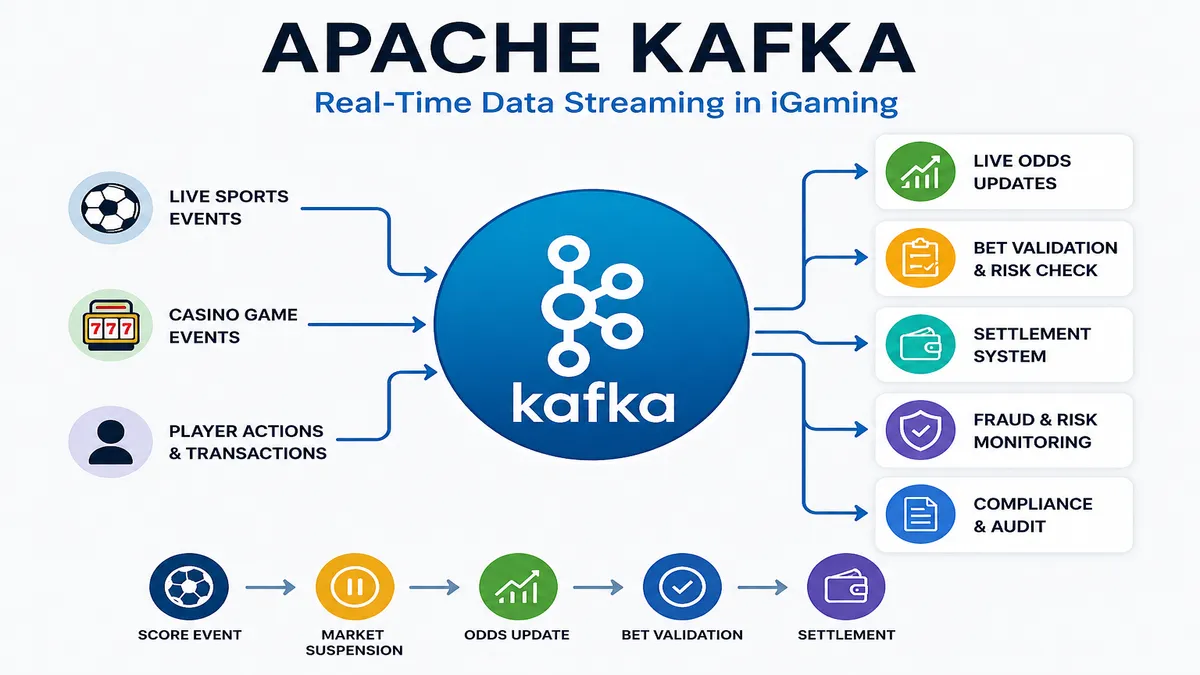
Apache Kafka can support different real-time workflows across an iGaming platform. The exact architecture will vary by operator and technology stack, but common event flows include:
Sportsbook
| Score Event → Market Suspension → Odds Update → Bet Validation → Settlement |
If you are watching a live match and a goal just went in. That single moment sets off many things behind the scenes; almost the market gets paused so nobody can bet at outdated odds. There is a new odds calculation, and once they match officially, it ends all the bets placed on it and gets fixed.
Online Casino
| Game Event → Wallet Transaction → Game State → Player Balance → Fraud/Risk Monitoring |
Every time you play an online casino game or spin a hand whatever it is that single action silently kicks off a bunch of parallel processes. The wallet system handles the money side and another system tracks the current state of the game, then your balance gets updated and in the background there is a risk system keeping an eye out for anything that looks off.
Live Casino
| Dealer Event → Game State → Betting Window → Market Closure → Result → Settlement |
Live casino works a bit differently because there has an actual dealer involved. Every action the dealer takes flipping a card or spinning a wheel changes the state of the game. From there, the betting window gets managed, the market closes, the result comes in and finally the bets get done.
Regulatory Reporting & Audit
| Event → Transaction → Retained Event History → Reconciliation → Reporting/Audit |
Here is the interesting part because the very same events generated in those flows above get used again. They become transaction records, get stored as history, go through reconciliation (basically checking everything lines up) and eventually feed into reporting and audits. One thing worth noting though is just keeping the data around is not the same as being compliant that still needs proper process around it.
Using Kafka for Live Odds Processing
A live odds engine requires timely information about the state of the event. The underlying architecture should be able to consume feeds of scores, cards, substitutions, player stats, or any other relevant information about the game.
Apache Kafka can serve as a transport layer to consume and further propagate this kind of information. Instead of establishing connections with all data providers and downstream consumers, one can build services on Apache Kafka that would normalise the events and store them in topics.
Apache Kafka Streams can be used to enrich, join, and transform these streams, although one should note that the documentation recommends doing heavy lifting with stateful operations such as windowed joins or aggregations in so-called local state stores.
The key point is that Apache Kafka serves as a streaming platform for specialised engines which process and enrich the events. It delegates business-specific logic to these engines which have the required domain knowledge.
Handling Event Time and Out-of-Order Data
One of the harder problems in live sports is that an event can happen before the system receives it. A goal may occur at 20:01:03, for example, but reach the processing layer several hundred milliseconds later. Kafka Streams needs the event timestamp to reason about the event in the correct temporal context. Notably, the Kafka Streams API makes a distinction between event time, processing time, and ingestion time. Whereas the first term refers to the time when the observed event has happened, processing time is the time when the application has processed a given record.
In particular use cases, it may be beneficial to rely on specific timestamp semantics to avoid making incorrect inferences due to network delays. As such, for a live sports scoring application, such nuances are of paramount importance, which makes timestamp extraction and event-time windowing so critically important.
Using Kafka in Betting Settlement Systems
Settlement engines require a different level of caution compared to regular analytics systems. Once the outcome has been formally decided upon, the settlement process needs to consistently apply the relevant business rules and keep an auditable trail of what happened.
With Kafka it is possible to decouple the event stream containing the upstream events needed for processing from the actual processing steps, which can be represented as a separate producer writing to another topic. This would make auditing easier, since the original event and any transformations would be separated but still present in the audit trail. It would also reduce coupling between downstream consumers by eliminating the need to directly consume from all upstream topics.
Must Read: 25 Red Flags of an Unsafe Online Casino: How to Spot a Scam Before You Deposit
Exactly-Once Processing and Transaction Integrity
Processing the same event more than once can have undesired side effects when it comes to financial or account-state transitions. In general, it is challenging to make applications that process such events idempotent.
With Kafka Streams, you can rely on exactly-once processing semantics, provided by Kafka itself, for end-to-end exactly-once processing.
This means that offsets, state-store updates, and output writes can be done atomically.
However, this does not automatically make your whole application exactly once, since other systems, such as databases or payment providers, need to be updated as well and might require their own transactions or idempotency checks.
Scaling Kafka for High-Volume Live Events
Live events create surges in traffic, where a significant uptick in activity can occur, overwhelming downstream services and creating a substantial ingestion, processing, and consumption load for any system handling the data.
Using Kafka’s partitioning capabilities can help distribute the processing load, allowing multiple instances of a Kafka Streams application to process records in parallel by partition.
But adding more partitions is not always the answer, since there are limits to how much a single application can consume, and overall, the system’s ability to process the data depends on the combination of several factors: partition keys, consumer’s capacity, broker resources, and downstream processes.
Designing for Failure and Recovery
Real-time systems cannot make the assumption that all components will always be available. Networks go down, services reboot and individual consumers can lag behind.
An event-streaming architecture is important for this reason because downstream consumers can replay retained records, rather than relying on upstream services to resend their data. Kafka’s stream-processing capabilities aid in this scenario when there is a need to reprocess data or to retain some processing state.
Operational teams should be aware of how much data downstream consumers are lagging behind, how long a record takes to process, failed records, partition health, and downstream system response time. It’s also important that recovery procedures are tested, not just designed.
Separating Odds, Settlement and Compliance Services
A proper architecture should not rely on a monolithic design, where all functions are performed within a single service. Odds calculation, market state management, settlement, reporting, and compliance features can be moved to separate services, which are integrated with controlled event streams.
Such an approach would reduce the impact of changes made to a particular part of the system. In addition, a proper event-driven architecture allows for easier debugging, as engineers would know precisely which event has triggered a particular behaviour, transformation, or validation.
Finally, an application needs to establish event ownership to enforce schema management policies and versioning strategies and prevent silent failures that can occur when incompatible data is processed downstream.
Building an Auditable iGaming Event Trail
For regulated iGaming technologies, the ability to provide a clear audit trail is essential. This includes the capacity to demonstrate reconciliation of accounts, investigate incidents and ensure overall compliance with pertinent policies.
The event-driven approach of Kafka can be leveraged to satisfy this requirement by storing the continuous stream of events that take place within the system. By retaining this information for a certain period, auditors will be able to reconstruct the series of operations that had occurred prior.
Nevertheless, the mere ability to store and replay events is not sufficient to fulfil regulatory requirements. The entity that wishes to use such a system must have the appropriate set of policies covering data security, retention, access control, compliance and other issues within its jurisdiction.
Monitoring Kafka-Based iGaming Systems
Real-time infrastructure needs real-time observability. Key metrics include end-to-end latency, consumer lag, throughput, processing failures, and the age of the latest event being processed.
In addition, teams need to ensure business consistency, as a technically healthy Kafka cluster is no substitute for an odds or settlement service that is producing incorrect results.
Alerts should therefore be set up that monitor application-level consistency in addition to infrastructure-level metrics. For instance, a sharp deviation between upstream business metrics and downstream business metrics may indicate a processing issue even if Kafka infrastructure metrics are normal.
Where Kafka Fits in the Modern iGaming Technology Stack
Apache Kafka should be regarded as an event-streaming infrastructure, not an odds or settlement platform. It is valuable because it ingests and relates evolving data to independently operated processes in a way that allows for scalable consumption, stateful computation, and reliable event sourcing.
Kafka Streams provides the means for continuous computations, state stores, event time processing, and custom processors.
Thus, the most efficient way to implement iGaming technology is to combine Kafka with appropriate data feeds, validation services, odds, engines, settlement platforms, databases, and monitoring tools. The bottom line is that real-time iGaming requires more than just low-latency pipelines. It needs timestamps, controlled flows, reliable processing, well-defined boundaries, and record-level auditing. In other words, Apache Kafka can be considered as the foundation for building such a system, but the choice of complementary systems will define whether the outcome will be a dependable and regulated solution.
FAQ
What is Apache Kafka used for in iGaming?
Apache Kafka helps iGaming platforms handle large amounts of real-time data, such as bets, player activity, transactions and odds updates. It keeps these events moving quickly between different systems.
How can Kafka support live odds?
Kafka can deliver live odds updates across betting platforms in real time. This helps sportsbooks keep odds and betting interfaces updated quickly during live matches.
Can Kafka be used for betting settlement?
Yes, Kafka can help move betting and transaction events to settlement systems. This allows bets to be processed and settled quickly while maintaining a reliable event history.
Does Kafka provide exactly-once processing?
Yes, Kafka supports exactly-once processing when it is correctly configured. This can help prevent the same betting event from being processed more than once.
How does Kafka handle high-volume sports events?
Kafka is designed to handle huge volumes of events and can scale across multiple servers. This makes it useful when betting activity suddenly increases during major sports events.
Why is event replay important for iGaming?
Event replay allows operators to go back and reprocess historical events when needed. It can be useful for troubleshooting, recovering from failures, audits and checking betting transactions.
Is Kafka suitable for regulated iGaming systems?
Yes, Kafka can be used in regulated iGaming environments when combined with the right security, monitoring, access controls and compliance processes. Its event-based architecture can also help maintain detailed records for audits.
